

MARKETS
Global Music Revenues Are Forecast to Rise as Subscriber Growth Beats Expectations

- Goldman Sachs Research expects global music revenues to grow at an annualized rate of 5.8% to almost $200 billion in 2035 from $112 billion in 2025.
- Paid subscriptions for music streaming have ample room to grow relative to gaming and on-demand video services.
- Our analysts see an opportunity for increased conversion from free to paid subscription tiers among older age groups.
- The market for live music is forecast to grow 6% in 2026 despite economic uncertainty, driven by a strong global arena and stadium business.
- AI represents an opportunity for the industry as streaming providers and tech companies use the technology to personalize algorithms, curate content, and transform passive listeners into active creators.
Global music industry revenues are expected to reach approximately $200 billion annually by 2035 amid an improving outlook for subscription streaming. New subscription models, AI, and direct-to-consumer offerings are creating opportunities for the industry to reach audiences in new ways, according to Goldman Sachs Research.
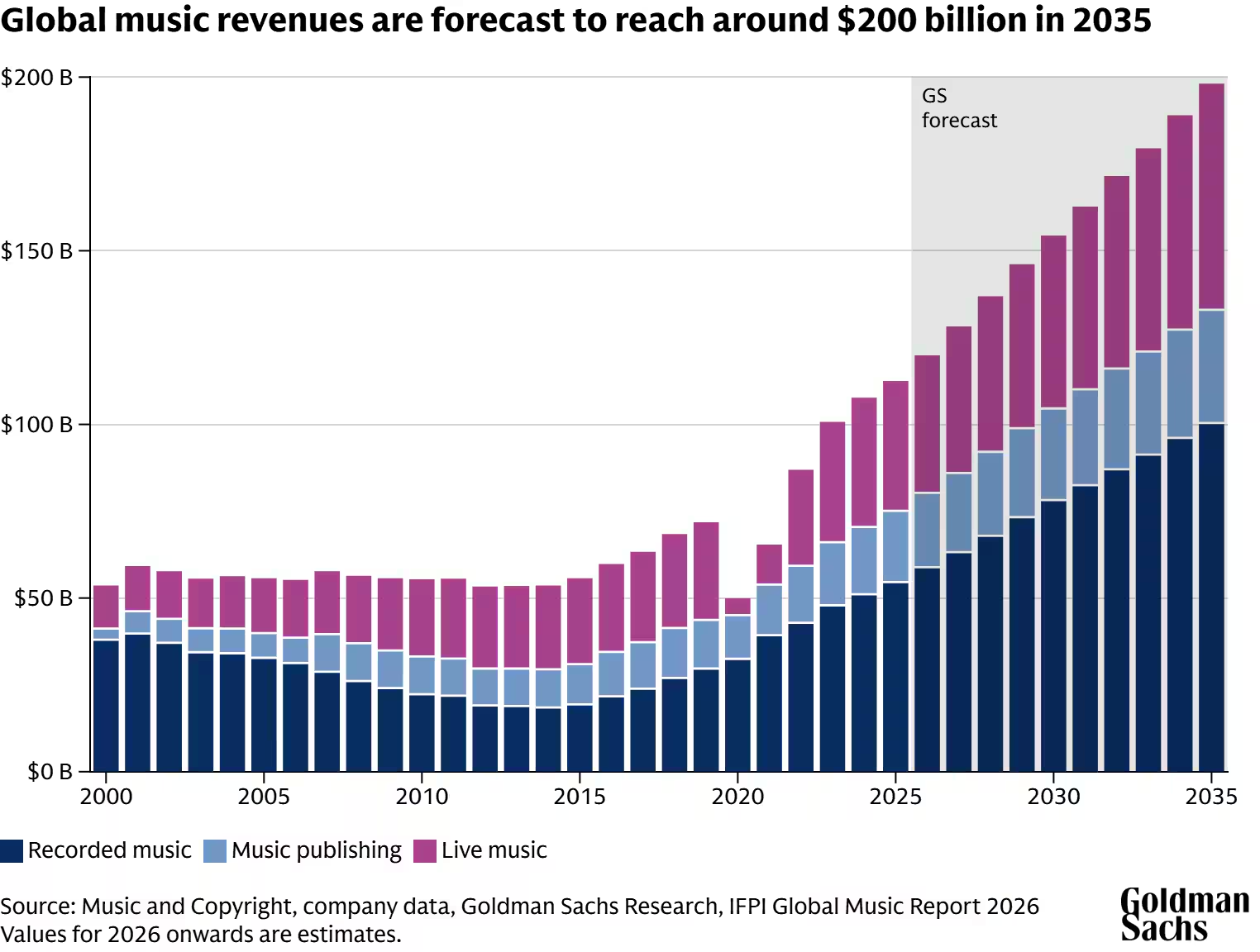
The music market undershot growth expectations over the last several years. The new forecast represents the first time in three years that Goldman Sachs Research has raised its long-term outlook for the industry, Stephen Laszczyk and Eric Sheridan write in the team’s 2026 edition of the annual “Music in the Air” report. Goldman Sachs Research expects global music revenues to increase at 6.7% year-on-year in 2026 and at a compound rate of 5.8% per year between 2025 and 2035.
“While growth is likely to moderate from the pace observed during the industry's streaming adoption phase, we continue to see a long runway for industry expansion supported by favorable consumer behavior and an increasingly diversified monetization model,” Laszczyk and Sheridan write.
Music streaming subscriptions are growing faster than expected
Paid streaming subscriptions are helping to shore up the outlook for recorded music. After three consecutive downgrades to its forecast for 2030 recorded music revenues, Goldman Sachs Research’s outlook for the segment this year reflects improvements in streaming revenue, physical revenue, and download and other digital revenue.
Subscription streaming revenue is growing faster, mainly because subscriber numbers are increasing more quickly than expected and revenue per user is rising in developed markets. Our analysts are factoring in more consistent price increases from streaming platforms as music labels increasingly incorporate higher royalties into their contracts and streaming platforms introduce new premium service tiers.
At the same time, increasing fan demand for vinyl and CDs is helping lift the outlook for physical music revenues in markets like Japan, South Korea, and the US. “We expect these trends to continue as fans increasingly view physical formats as collectibles rather than as a way to listen, and as artists incorporate physical formats into their album rollouts and tour experiences,” Laszczyk and Sheridan write.
Which markets will drive the growth of music?
Paid subscription streaming revenue beat our analysts’ expectations in 2025, and Goldman Sachs Research expects further growth ahead, driven by emerging markets. Laszczyk and Sheridan forecast the percentage of internet users with paid streaming subscriptions in emerging markets to rise from 10% in 2025 to 15% in 2035, with subscriber numbers boosted by growing populations and increasing internet penetration.
Paid subscriptions in developed markets also have room to grow, according to Laszczyk and Sheridan, who expect the number of paid subscribers in the US, Canada, Europe, and Australasia to rise to 568 million in 2035 from 398 million in 2025.
Only around 53% of Americans subscribed to paid music streaming in 2025, compared with around 60% for gaming and 90% for on-demand video. Goldman Sachs Research expects most developed markets to approach peak penetration for paid music streaming at 60% by 2035.

Older age groups and new products could help drive paid music users
Older listeners could be an untapped audience. Data from the UK shows that older listeners are less likely to use paid streaming and less likely to convert from free to paid users.
“We see opportunity for increased conversion from free to paid among older age groups, especially as younger age cohorts who are heavy users of paid streaming services grow older, and as streaming providers adapt their marketing strategies to target older demographics,” Laszczyk and Sheridan write.
Introducing an ad-light tier could also help streaming providers drive subscriber acquisition. Goldman Sachs Research estimates that a small incremental fee of around $1-2 per month for a reduced advertising load could result in subscriber growth. “This follows a similar playbook to what has already been implemented in video streaming,” Laszczyk and Sheridan observe.
If 10% of free streaming users in developed markets shifted to a $1 ad-light tier, global ad-supported revenues would rise by around 8%, Goldman Sachs Research estimates.
Another emerging opportunity in streaming is direct-to-consumer offerings, where artists build a direct relationship with their fans without an intermediary platform controlling access to that audience.
This innovation is still in its early stages, Laszczyk and Sheridan write. But “if this ecosystem continues to develop the way it has been, the direct-to-consumer opportunity could grow from representing tens of millions of dollars of revenue today to hundreds of millions over the next decade.”
Increased touring and new venues are buoying live music
Despite pressure on consumer wallets from tariffs, gasoline prices, and higher interest rates, our analysts expect the market for live music to grow 6% in 2026, driven by a strong global arena and stadium business.
This supports Goldman Sachs Research’s thesis that demand for live events has increased globally since the Covid-19 pandemic, and that the sector is less exposed to economic downturns than other forms of discretionary spending.
Looking ahead, our analysts expect live music to grow at a similar 6% compound rate through 2035, underpinned by an increasing supply of diverse and popular artists touring over the next decade.
Stronger financial incentives to tour and efforts by record labels to promote new talent are set to drive the live music sector, Laszczyk and Sheridan project. And they expect venue capacity to grow, with operators poised to open several dozen new music venues around the world in the next five to seven years.
How will AI impact the music industry?
AI’s impact on the music industry has been “the biggest debate among music investors over the last year,” Laszczyk and Sheridan say. One concern is that AI-generated music will displace human artists, but Laszczyk and Sheridan believe that fear is overblown for higher-profile artists in the near term. While the team does see some potential for cannibalization by AI over the long term, they expect that it will mostly be limited to lower-value music (including background and study music as well as mid-tier artists).
Only a mid-single-digit percentage of consumers used an AI music generation tool at least monthly as of the fourth quarter of 2025. As of the third quarter of 2025, around 55% of music creators had used an AI tool in the past year, but mostly for production workflow or mastering rather than to generate entirely new songs.
At the same time, AI represents an opportunity for music labels and rights holders: Streaming providers and tech companies can use the technology to personalize recommendations, curate content, and turn passive listeners into active creators.
“We believe that monetization will ultimately make its way back to the rights holders in a way that we think will disproportionately benefit some of these higher-end artists where AI music is likely created off of their image and likeness, their melodies, or their lyrics, given how popular they are,” Laszczyk says.
This document has been prepared by the Goldman Sachs Executive Office and is not a product of Goldman Sachs Global Investment Research. The opinions and views expressed herein are as of the date of publication, subject to change without notice, and may not necessarily reflect the institutional views of Goldman Sachs or its affiliates. The material provided is intended for informational purposes only, and does not constitute investment, legal, or tax advice, a recommendation from any Goldman Sachs entity to take any particular action or be used as a basis for any other investment decision, or an offer or solicitation to purchase or sell any securities or financial products. Any forward-looking statements, case studies, computations or examples set forth herein are for illustrative purposes only. Past performance is not indicative of future results. Neither Goldman Sachs nor any of its affiliates make any representations or warranties, express or implied, as to the accuracy or completeness of the statements or information contained herein and disclaim any liability whatsoever for reliance on such information for any purpose. Each name of a third-party organization mentioned is the property of the company to which it relates, is used here strictly for informational and identification purposes only and is not used to imply any sponsorship, affiliation, endorsement, ownership or license rights between any such company and Goldman Sachs. This material should not be copied, distributed, published, or reproduced in whole or in part or disclosed by any recipient to any other person without the express written consent of Goldman Sachs.




Subscribe to Briefings
Our weekly newsletter delivers the latest insights on economic forces shaping markets—from Goldman Sachs leaders, economists, and investors around the world.
You can unsubscribe at any time. For information about how your personal data will be used, visit Privacy Information and Resources.