

Talks at GS
LSEG CEO David Schwimmer on Where Global Capital Is Moving
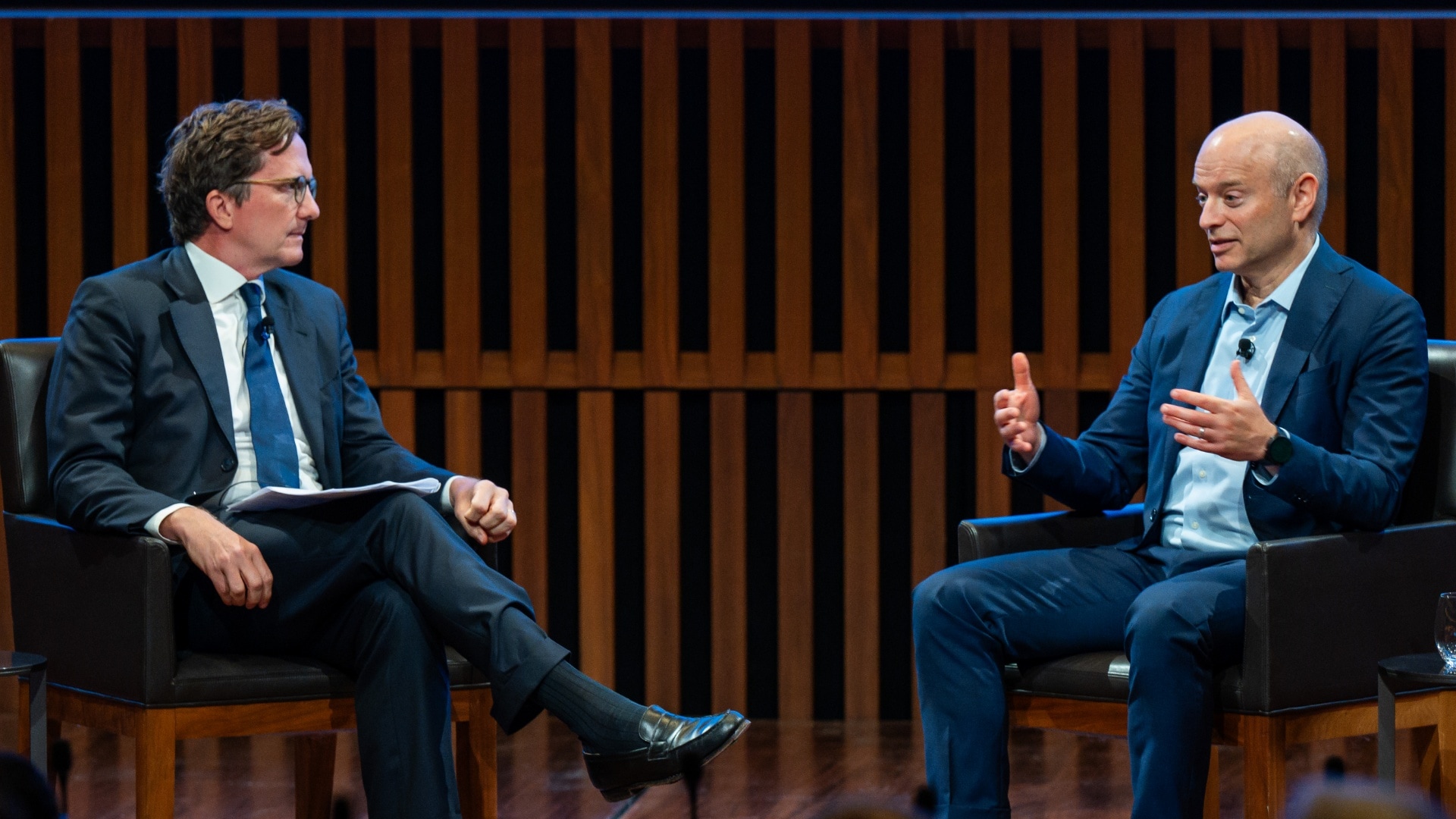
David Schwimmer, CEO of London Stock Exchange Group, explains why investors may be underestimating risks in today’s markets. In particular, Schwimmer says inflation and geopolitical tension limit the policy flexibility that has supported markets in past downturns. In conversation with FX de Mallmann, chairman of Goldman Sachs EMEA and chairman of Investment Banking, Schwimmer describes scenario planning as a more practical discipline than trying to predict what happens next.
Transcript:
David Schwimmer: I often say this is a statement that I learned from Lloyd, actually. I am not in the prediction business, but I'm in the scenario planning business. I think there are many different scenarios right now where things could get pretty volatile.
[MUSIC INTRO]
FX de Mallmann: Welcome to Talks at GS. I'm FX de Mallmann. I'm very pleased to be joined today by David Schwimmer, who is Chief Executive Officer of the London Stock Exchange Group, a Goldman Sachs alumnus who spent 20 years at the firm. The LSEG group is a leading markets infrastructure and data provider. It is very well known to own and operate the London Stock Exchange. What's less well known is the London Stock Exchange is only a very small part of its overall business. That's organized according to a number of key businesses around data and analytics, capital markets, risk intelligence, and post-trade.
David's been leading LSEG since 2018 through one of its most ambitious transformation in the company's history, really moving it from a traditional regional exchange group to a very large global data analytics powerhouse. So, David, thanks for joining. Welcome.
David Schwimmer: Thank you very much, FX. It's great to be here.
FX de Mallmann: Before we jump into markets and into LSEG, I just wanted to focus on you. You spent 20 years as an investment banker advising other people and other people's companies, and then you took the seat on the other side of the table running a very large public company. Take us back to that moment when you got that call. What went through your mind and how did you decide to switch sides?
David Schwimmer: I had had a great 20 years at Goldman. I loved my time here. I had done a bunch of different things. It was a little bit of an unusual path. I started in FIG, as I just mentioned. I spent a year and a half or so as Lloyd's chief of staff. And then after that, I went and ran the Russian business for Goldman. And then after that, I spent several years running metals and mining, all within investment banking. And then was doing both metals and mining and market infrastructure, which was a bit of an unusual combination.
And so, I'd had a fascinating period of time where I really had a number of different roles. But I also felt that I didn't want to end my career retiring from Goldman Sachs. So, when this call came in, it was an opportunity to take on a role at a big, important institution that I had never actually worked with. I'd worked with exchanges all over the world. Market infrastructure all over the world. I'd never actually worked with LSEG. I thought, okay, that would be really interesting. And it would also be a real challenge.
There were a lot of things going on at LSEG at that time, both on the macro front with respect to Brexit and how the UK was going to navigate that. There were some challenges associated with some corporate governance. There was an activist in the stock. So, there were all kinds of things about it, whether you would call them red flags or really interesting challenges, I thought they'd be really interesting challenges.
So, I called up my wife and I said, "How would you feel about moving to London?" And she was intrigued as well. So, then I went into the process and, of course, a multi-month process. But here we are.
FX de Mallmann: Switching to market, you've lived and operated and worked through many market cycles. I've heard you recently saying that you felt the markets were in a state of rational complacency. Where are we in this cycle today? And how would you describe market conditions and the environment?
David Schwimmer: Yeah, so I referred to that phrase of rational complacency really in the spring when there was this sort of question of why aren't the markets reacting much more dramatically to what was going on in the world, particularly with respect to an energy crisis associated with the war in Iran. And the point I was making at that point was that for most of the investing careers of many people in the markets, it has been very rational to, I'll say, buy the dip. And if you really go back to the late 1990s and the Greenspan put, whether it was intentional or not, there was this perception going back to that period that the Federal Reserve would step in and make sure that things would be okay whenever there were wobbles in the market.
And so, you had a whole generation of market participants who were kind of trained on that belief. And if you look back over the last 25 years, it's pretty accurate in that you have had lots of wobbles in the market and you have had lots of sort of market disruption and definitely corrections and, of course, the financial crisis. But in every one of those times, you have seen both through fiscal policy and monetary policy, you have seen governments, not just the US, but you've seen governments step in to basically try to rescue or improve the market environments.
So, if you're an investor and you're looking at that track record, you're thinking, okay, yes, there's a war in the Middle East. Yes, there's an energy crisis. But the government's going to do everything it possibly can. And the Central Bank's going to do everything it possibly can to fix that and improve that. And you know what? In the spring, the markets were right. And the US administration today is an administration that is particularly sensitive to the markets. And so, you have seen the US administration do everything it possibly can to minimize energy prices and to try to protect the markets.
The point I also made in the spring was that you could see that notion of rational complacency based on the track record of the last 20 plus years tipping into irrational complacency. And I think we're now in a position where and, you know, the markets are pretty smart. You're seeing a lot of questions and a lot of concerns about both fiscal and monetary policy to deal with the current situation.
I think over the last 25 years, you did not have big issues with inflation. And when you don't have big issues with inflation and you have a declining rate cycle for 20 plus years, that gives a lot more flexibility to governments and central banks in terms of pulling those levers.
So, I think the inflationary environment is very different right now. And I think that the geopolitics are very different right now. And so, I think the notion of the rational complacency that you saw that I was talking about in the spring, I think we're seeing both a concern, and a risk in some areas, that people are still being too complacent and that rational tipping into irrational.
FX de Mallmann: So, David, from your seat, you have an extraordinary window on capital formation, capital flows. Where's capital flowing today? And any areas, regions, or asset classes that may surprise the audience?
David Schwimmer: So, I think a big driver of capital flows today, if you go back to the beginning of this year, before the conflict in Iran, there was a lot of capital that was trying to diversify away from the US. We've gotten into this position where the US capital markets, the US is roughly 25% of global GDP, yet the US capital markets, depending on how you want to measure them, are two to three times that percentage of global market cap. You know, that's an aberration that will not last forever.
And just to put that into some kind of historical context, you know, if you go back to the Japanese equity market boom in the 1980s, Japan was 40% of global market cap. Today, Japan is about 4% of global market cap. So, these things can move around a lot. I'm not saying that the US is going to go down that extremely.
But what you saw at the beginning of this year was investors were trying to reallocate their capital and find a little bit more of a balance, a little bit less exposure, both to the US markets and to the dollar. That was basically paused by the war in Iran, because the US is perceived to have a stronger position relative to Europe and Asia with respect to energy and being more independent in terms of oil and gas in its own markets. So, not being so exposed to higher energy prices. So, that led to either a pause or a shift in capital going back into the US.
I think we're now seeing those trends basically being crosscurrents. And I think the investors that we interact with or that we talk to, they still want to have that exposure to the US and the dynamism of the US economy. But there is nervousness about the concentration risk in the US to specific companies and also to AI in general. And a recognition that both with respect to their dollar exposure and US equity exposure, it has gotten larger. Largely because of the significant growth there. And this is not a flood of capital, but a modest reallocation of capital into Europe, into Asia, into some emerging markets. And it'll be interesting to see how those crosscurrents play out.
FX de Mallmann: So, we sit in London today. There's been some debate around London and the UK's ability to attract and retain some of the best and higher growth tech companies in particular. From your vantage point as a listing venue, what do you see in your pipeline for IPOs, new listings? And is there anything that the UK should do to address any of the gaps versus other regions in the US in particular, whether it's regulatory or otherwise?
David Schwimmer: A number of things have been done over the last couple of years that have helped reform the UK listing environment. And it's now much more competitive, much simpler, much more attractive. And we are seeing the pipeline, the IPO pipeline for the UK markets, stronger than certainly any time that I've been in the role. And if we sort of check the pipeline record, stronger than anything that we've seen really in 15 plus years. So, we'll see that play out, I would say, the remainder of this year and early in 2027.
Having said that, I think there are some things that the UK can continue to do to make it more attractive. The UK has the third largest pool of pension assets in the world after the US and Japan. A couple aspects of that that are not working as well as they should. First of all, the the average pension fund in the UK is much smaller. It's an average size about 300 million pounds, which means they're basically investing in index funds and gilts, the UK government bonds, as opposed to having the scale and sophistication and the management to be much more diversified - private equity infrastructure, venture, as well as public equities.
The other challenge that we have seen among the UK pension funds is that over the last 20, 25 years or so, because of some regulatory incentives, you have seen UK pension funds reduce their exposure to UK equities from roughly 40% of their holdings to roughly 4% of their holdings. So, a 90% decline.
What that means is that we have more investment in the UK equity markets from, for example, one Canadian pension fund than from UK pension funds, which sort of, if that sounds shocking, it should be. So, there's an opportunity to reform the pension funds here, make them bigger, more concentrated, more sophisticated. And that's happening, but that will take some time.
And then I think there's an opportunity to incentivize more of that capital being in the domestic market and supporting the economy where those pension assets are coming from.
FX de Mallmann: Moving on, AI has become one of the biggest, you know, forces and source of capital allocation in markets. You have spoken about the three legs of the AI stool. Explain to the audience and listeners what these three legs are, what trends are impacting each of the three, and where LSEG, you sit.
David Schwimmer: Yeah. If you think about what the drivers of the AI ecosystem are, and this is what I've talked about in the past, it's sort of the three legs of the stool. You have the compute, the computing power. That means the data centers and the chips. You have the models. And then you have the data that goes into those models and informs those models. So, those are sort of the three legs of the stool.
If you think about what's happening to each of those, with respect to the compute, it is about supply and demand. And there's an enormous amount of capital going into both building the data centers and also developing new chips.
You're seeing more and more companies develop other chips. You're seeing lots of investment going into data centers. So, that leg of that stool, getting a lot of capital. Supply and demand will eventually find an equilibrium. We'll see how that plays out, whether that's a smooth equilibrium or it's a bumpy road to get there. And then the chips are coming along.
In terms of the models, huge amount of capital going into the models. And in many ways, a commoditization in that space as well. And we're seeing this debate play out. We've got the frontier models. We've got the open weight and open-source models. Some of them are US, Canadian, French, Chinese. What do the economics of that look like? And is there risk of commoditization there?
Then the third leg of the stool is the data. And you are seeing a lot of value placed on data. And I think a lot of companies are recognizing how important it is, how valuable their data is. And the interesting thing about data is you cannot just throw money at data to commoditize it or to create more data. You can create synthetic data, but that's only as good as the data that it is derived from.
That's the area where we really have a very strong hold and strong position in this AI ecosystem, because we have such extensive, credible, auditable data. And it's becoming more and more valuable in this AI world.
FX de Mallmann: David, you're very familiar with the Goldman Sachs culture and how much time and effort we put in into fostering it and investing in it. When you joined LSEG and you evolved it through such a large acquisition, how have you set yourself the agenda to evolve the culture there? How has it moved? And what were the key levers and initiatives you drove to evolve the culture?
David Schwimmer: So, one thing I definitely took with me from Goldman Sachs was the importance of culture. That doesn't mean I was trying to replicate the GS culture at LSEG. But when we acquired Refinitiv, we spent a lot of time focusing on getting the culture right and evaluating what the culture of LSEG was, what the culture of Refinitiv was, what were the best aspects of each. And we basically made an effort to create a new culture because we had so many new people. This was such a transformational transaction. We didn't want it to be a sense of we're the buyer; we're imposing the culture here. And we spent a lot of time and energy trying to get that right. And I think we got to the right place because we did not have any sort of tribalism. We didn't have a sense of, you know, it's this team versus that team. Everyone wanted to be part of the new company that we were building and recognized what an opportunity that we had there was. So, that importance, the emphasis on culture, I think, served us really, really well.
FX de Mallmann: And practically speaking, what were the key steps in executing this? There's a message from the top. And then how do you roll it out on an organization of this scale?
David Schwimmer: In terms of creating that new culture?
FX de Mallmann: Yes.
David Schwimmer: So, first it was basically the diagnostic work. What are the important elements of this culture? What are the important elements of this culture? What parts do we want to extract from here? What parts do we want to extract from here? What parts do we want to change?
Then a lot of it was about communication, modeling, and incentives. And the incentives could be both hard incentives, but with culture hard incentives meant-- by hard incentives, I mean monetary incentives or incentives in your compensation, or soft incentives. And when you're building a culture, you can use both. And we relied mostly on the soft incentives, the modeling, and the communication.
And there was a very receptive audience, if I can put it that way, in terms of our workforce. People really were excited about bringing these companies together.
The other thing that is important in a transformational situation like that is helping people navigate the change. When you are driving change, it can feel really exciting and empowering and energizing. If change is happening to you, that can be really hard. And it can feel the opposite. It can feel disempowering. And it can make you feel insecure.
So, we were going through an enormous amount of change in an environment when the world was going through an enormous amount of change. We closed the transaction in the middle of the pandemic. And we were doing all of the integration work over screens, which was not ideal. And it was very difficult and very stressful for people.
So, the notion of helping people get through that by believing that they were part of driving the change, as opposed to having this change imposed on them, I think was an important aspiration. The reason I describe it as an aspiration, it wasn't easy. And it was a difficult and challenging and stressful time for people. But I think that dynamic around change is an important thing to recognize when you are going through that or when an organization is going through that.
FX de Mallmann: So, your industry markets, infrastructure, and data is changing quickly. You're changing very quickly. Roll the clock five to 10 years. How does the landscape, your competitive landscape look like? How does LSEG look like in that competitive landscape?
David Schwimmer: Well, when you think about how the world has changed in the last five to 10 years, the notion of thinking forward five to 10 is--
FX de Mallmann: Very difficult.
David Schwimmer: Yes. But I think you will see us being really the industry standard, sort of default offering for information services and infrastructure for this industry, for the financial sector. And there will be a couple of key drivers of that, some of which we've touched on here. AI is going to become more and more an embedded functionality. And that brings a very powerful capability to us.
Our industry is so complex. I think you all are probably subject matter experts in different parts of a very complex industry. And in many ways, technology has been making things more and more complicated over the last 20 years. If you think about when you and I started our careers, the world was a very different place and in some ways a lot simpler. What we now have with AI is the ability for the technology to go from being complicating to simplifying. And I think that is a very powerful opportunity in the context of taking all that we offer, the breadth of our offering across financial markets, and making it available to you in a much simpler manner. Effectively through sort of a single pipe where you can communicate with natural language, "this is what I need, help me do this." And then have access to the huge breadth of offerings that we have across LSEG. Where we already work with you across, it's certainly more than dozens, probably hundreds of different parts of Goldman Sachs. So, that notion of simplification I think is going to be very powerful and very helpful over the coming years.
The other aspect that we haven't really touched on is digitization. And we're not going to wake up on a Monday morning, and the world will have moved from analog to digital. This is going to be with us for probably that five-to-10-year timeframe that you're talking about. But we are going to see it have a big impact in terms of each of the different parts of the financial market infrastructure value chain. And I think it will be quite meaningful. And probably not for today's discussion. There are a lot of different things we're doing in that space in terms of building out digital market infrastructure, creating real time settlement in commercial bank money across a bunch of different areas. So, I think that will also be a big significant shift over the coming years.
And just the whole notion that capital raising is tied to particular geographies today. You know? The notion that a company goes to the London Stock Exchange or the New York Stock Exchange or Hong Kong Exchange to raise capital is going to be somewhat anachronistic. And you'll need a regulatory medallion. You'll need some regulator to bless those transactions. But those transactions will at some point be independent of geography. That'll be another significant shift.
FX de Mallmann: Interesting. We'll close on this, David. Thank you so much for being here today. Congratulations on a great track record. Good luck to you in this next period.
David Schwimmer: Thank you. And thanks again. Appreciate it.
FX de Mallmann: Thanks very much.
This episode was recorded on September 2, 2026.
The opinions and views expressed herein are as of the date of publication, subject to change without notice, and may not necessarily reflect the institutional views of Goldman Sachs or its affiliates. The material provided is intended for informational purposes only, and does not constitute investment advice, a recommendation from any Goldman Sachs entity to take any particular action, or an offer or solicitation to purchase or sell any securities or financial products. This material may contain forward-looking statements. Past performance is not indicative of future results. Neither Goldman Sachs nor any of its affiliates make any representations or warranties, express or implied, as to the accuracy or completeness of the statements or information contained herein and disclaim any liability whatsoever for reliance on such information for any purpose. Each name of a third-party organization mentioned is the property of the company to which it relates, is used here strictly for informational and identification purposes only and is not used to imply any ownership or license rights between any such company and Goldman Sachs.
A transcript is provided for convenience and may differ from the original video or audio content. Goldman Sachs is not responsible for any errors in the transcript. This material should not be copied, distributed, published, or reproduced in whole or in part or disclosed by any recipient to any other person without the express written consent of Goldman Sachs.
Subscribe to Briefings
Our weekly newsletter delivers the latest insights on economic forces shaping markets—from Goldman Sachs leaders, economists, and investors around the world.
You can unsubscribe at any time. For information about how your personal data will be used, visit Privacy Information and Resources.