Funding the Next Infrastructure Cycle: The Evolving Financing Playbook


- AI is turning infrastructure investment into a long-term capital cycle.
- The buildout is fueling “an entire second generation” of the AI economy.
- Funding the next phase will require a broader financing playbook.
While the AI buildout is inherently a technology race, the scale of investment now underway suggests it is equally a capital formation challenge. Scaling AI requires investment in a much wider buildout of physical infrastructure, creating capital needs across data centers, power, networks, construction, equipment, and more.
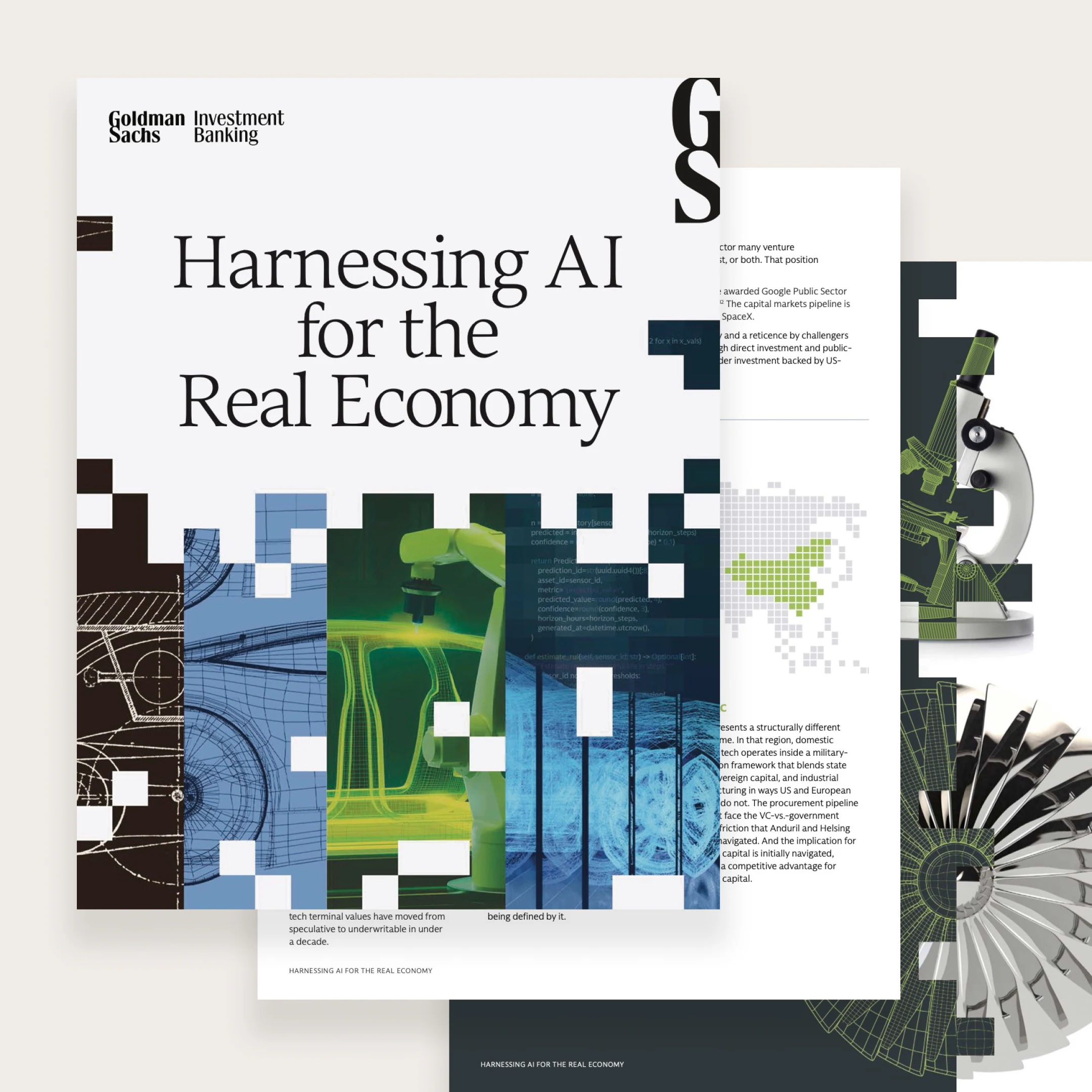
The magnitude of the buildout has also risen sharply. Just a year ago, estimates for AI infrastructure investment over a five-year period lay between $3 trillion and $5 trillion. Earlier this year, the Goldman Sachs Global Institute approximated that number could reach $8 trillion over the next four to five,1 while other sources have more recently estimated it could swell past $10 trillion.2 That investment is not likely to be a one-time deployment, as a substantial share of AI spending is directed toward equipment inside data centers that requires more frequent replacement.
“This is not a one-time $10 trillion investment,” says Mahesh Saireddy, global co-head of the Capital Solutions Group within Global Banking & Markets. “Technology will continue to evolve, driving recurring investment cycles for years to come.”
Financing an Expanding AI Ecosystem
The direct beneficiaries of the AI buildout are well known: hyperscalers, chipmakers, data center operators. But the investment cycle is creating demand throughout a broader ecosystem of businesses and assets.
“It is creating an entire second generation of the AI economy,” Saireddy says, pointing to cloud providers, data center construction companies, and power-related businesses.
Goldman Sachs Research expects global data center power demand to increase by 170% between 2025 and 2030, with more than 60% of that growth coming from the United States.3 Yet the infrastructure opportunity remains a global one, with investment activity accelerating in Europe and Asia as well.
Still, AI is not the sole driver of capital markets activity. The broader story includes continued growth in alternatives assets, renewed M&A financing needs, and a global infrastructure buildout extending beyond AI alone.
Capital Is Expanding Beyond Traditional Channels
Alternative asset managers, historically invested predominantly in private equity, are growing larger and more complex, demanding a broader set of financing solutions across private credit, infrastructure, insurance capital, derivatives, and long-duration investment strategies.
“Now everyone has become large, diversified alts,” Saireddy notes, adding that as those businesses grow, so does the need for tailored financing across different asset classes.
That expansion is taking place against a more challenging backdrop for traditional private equity. Saireddy notes that average disposition times have risen to more than seven years, leaving many sponsors with older assets to manage while exit activity remains subdued. While he expects some of those assets to clear over the next year or two, he remains constructive on private equity’s longer-term role, especially given the scale of the global equity market.
Private credit is a particularly important part of that evolution, but it is no longer synonymous only with direct lending. Private investment-grade lending makes up the second phase of private credit’s development, supported in part by alternative managers’ insurance platforms and separately managed accounts.
Saireddy says that for long-duration assets such as data centers and related infrastructure, private investment-grade capital can especially be a natural fit: “Data centers have a lot of duration too, which is a great asset to go into the insurance platforms.”
Going forward, private capital will play an increasingly complementary role alongside the public markets, as the AI buildout calls for greater coordination across capital sources. The right financing mix will depend on an asset’s size, duration, risk profile, and where it sits in the development cycle.
Financing at Scale Requires Discipline
Companies with substantial financial capacity are driving the AI investment cycle, with Saireddy noting that the largest hyperscalers remain relatively low-levered and with “massively positive free cash flow,” providing a strong foundation for continued investment.
But funding the next AI growth phase will not be linear. Assumptions around AI monetization and the viability of the broader buildout will continue to evolve, as will credit spreads and valuations.
“There will be market corrections,” Saireddy cautions.
Ultimately, Saireddy believes that the supercycle will get financed. But spreads may fluctuate with supply, and equity investors are likely to remain especially discerning. The IPO market remains open, but investor demand is concentrated in growth-oriented and AI-linked businesses rather than spread evenly across sector and issuer type.
Capital coordination will emerge as a defining feature of this technology supercycle. For companies and investors that can align the right capital with the right assets, match financing duration to infrastructure life cycles, and thoughtfully combine public and private solutions, the opportunity is substantial.
Endnotes
1 Harnessing AI for the Real Economy, Goldman Sachs Investment Banking (2026)
2 Financing the AI Buildout, The Brookings Institution (2026)
3 Navigating a System of AI Bottlenecks, Goldman Sachs Investment Banking (2026)