

Talks at GS
Demond Martin on Purpose, Community, and Giving What You Have
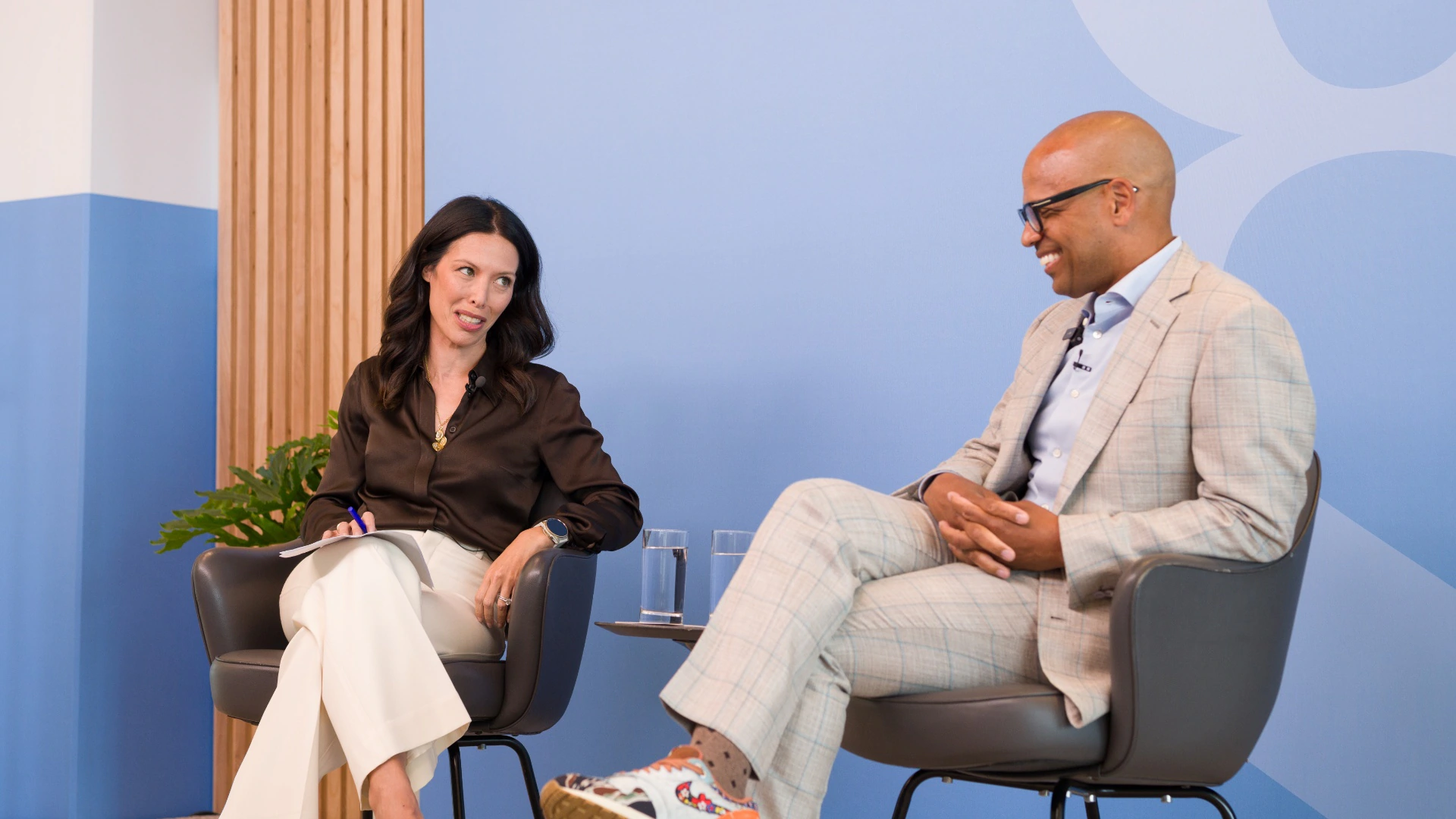
WellWithAll is a purpose-led health and wellness company built on an inclusive capitalism model that reinvests 20% of its profits into health-equity initiatives to help close the wellness gap across generations. Demond Martin, co-founder and CEO of WellWithAll, joins Kim Posnett, global co-head of Investment Banking at Goldman Sachs, to discuss his transition from a 21-year career on Wall Street to becoming a founder, and how his philosophy of building deep, value-aligned relationships—as described in his book Friends of the Good—has shaped his approach to mentorship and leading a mission-driven business.
Transcript:
Demond Martin: There's this false narrative that we're self made. And we're not. We're community built. The people that you surround yourself with are actually what drive your future.
[MUSIC INTRO]
Kim Posnett: Welcome to another session of Talks at GS. Today I am delighted to be joined by Demond Martin. He is an investor, a philanthropist. He's a co-founder and CEO of WellWithAll. The company operates on an inclusive capitalism model. Reinvesting 20% of its profits into health equity initiatives to help close the wellness gap across generations.
Before WellWithAll, Demond spent 21 years on Wall Street as a senior partner at Adage Capital Management where he invested in the consumer sector and he helped grow the firm's assets to more than $40 billion. He began his career serving as the assistant to Erskine Bowles, White House Chief of Staff to President Clinton. You've got a lot going on.
Demond Martin: Are you still talking?
Kim Posnett: Yeah. Exactly. He leads his family foundation with his wife Kia Martin. So, anyway, welcome. Welcome.
Demond Martin: Thank you. Thank you.
Kim Posnett: Thank you for being with us.
Demond Martin: It's a pleasure to be here.
Kim Posnett: Let's start at the beginning. So, your early life took you from Columbus, Ohio to Inglewood to Huntsville, North Carolina. Take us back to those early years and what that period was like and how did that early journey shape your drive for independence, for success, for purpose?
Demond Martin: So, I've lived this improbable but possible life where, you know, grew up in poverty. So, born in Columbus, Ohio. Parents get a divorce. My mother decides to move the two of us to California for, you know, brighter horizons. But it was Inglewood, California. So, as a kid I saw things that kids should never see. But it certainly has given me perspective and resilience and focus at this point in my life.
Right before high school, I would visit my father in North Carolina every year. And I said to him, "I'm supposed to go to Inglewood High. I'm gonna die if I go there." So, he said, "Come live with me." So, I moved into a single wide trailer in rural North Carolina. But I lived.
When I was in high school, my cousin Mo, who's five years older than me, would let me come and visit him. And you know, when I went to Duke, I experienced just a whole new atmosphere and world. I saw all these talented Black folks that were driven and, you know, had this extraordinary perspective. And it just changed my focus. I knew I needed to be in an environment like that.
Kim Posnett: Let's shift from that early life experience to what you're doing now. Okay?
Demond Martin: Okay.
Kim Posnett: So, you know, WellWithAll. It was inspired more by lived experience than like a specific hole in the marketplace. What was the problem that you witnessed or felt compelled to solve? And you know, why did that become what you wanted to build this company and mission around?
Demond Martin: I mean, the reality is like I lived this childhood of poverty. And then an adulthood of, you know, some real financial successes, you know, being a partner at Adage for all those years. And that allowed my wife and I to become philanthropists and invest in health equity and education.
But five years ago, you know, was standing in the middle of an emergency room with someone that I loved dearly dealing with depression, anxiety, and was suicidal. And in the worst moments of that, what I realized with the greatest clarity is, like, now I was on the other side of inequity where I knew the CEO of the hospital.
What I reflected on is that if this was me at 14 living in that trailer in rural North Carolina, I'd be dead or in jail. Like, those were my real options. And a lot of people are in that position right now. And I thought that starting another philanthropic organization wouldn't be the answer because I'd be out, you know, asking people for money.
And so, I thought about how we could actually do something different. So, WellWithAll is a health and wellness consumer products company, and we take 20% of the profits of everything that we sell and use that to impact health equity.
Kim Posnett: But so, didn't you at the beginning consider having WellWithAll be a non-profit?
Demond Martin: Before it was WellWithAll, I thought about the different angles. And the reality is the need to raise money constantly was not an option, right? We live in this time where there's not enough philanthropic capital. There certainly isn't the political will or the tax dollars to solve the problems that society has. And so, corporations are going to need to play a much greater role.
So, we built a company where our mission is to create generational wellness. So, the mission and the business purpose are inextricably, you know, tied together.
Kim Posnett: You spent 21 years at Adage Capital. You analyzed thousands of companies as an investor. Maybe spend a little bit of time talking about sort of the transition from being an investor to being a founder/CEO of your own company.
Demond Martin: It's all about the people. And even as an investor, I focused heavily on the people. I understood thoroughly every one of the business models. But the humans are the individuals that get things done or not. The individuals are the ones who make the decisions and pivot and adjust to get to the finish line.
And so, that thought process, that understanding-- and also, you know, being a part of helping, you know, build Adage from early days, those lessons well informed how do you assess people. How do you understand if there's a true expertise or an AI-driven resume? And getting the right group of people together to do this has been critical.
Kim Posnett: When you set out to build WellWithAll, tell us who was the first call you made. And why?
Demond Martin: My co-founder Carmichael Roberts. He's, you know, someone I've known for 26 years plus. And he's built dozens of companies. But he's also somebody that I've talked to about impact, talked to about creation, entrepreneurship. He had a skill set that I didn't, which was super important. And he was a human that I trusted with my life.
Kim Posnett: I really agree with you on this concept of trust, and you can do your best work when you're in an environment where you trust people you're with. Maybe spend some more time talking about that philosophy because I think it's so important.
Demond Martin: So, I've written a book called Friends of the Good. But the framing of that borrows from Aristotle, who believed that friendship was one of the most essential elements of joy. And he bucketed friendship into three categories. Transactional. You scratch my back, I scratch yours. Friends of pleasure. We might go out and party together. And friends of the good, you know, are individuals where you share a value. Right?
But transactional and friends of pleasure, those are fleeting in nature because when the transactions go away, so does the friendship. When the pleasure goes away, when the fun goes away, so does the friendship. But friends of the good, that's an enduring friendship that you stay with. And so, those are people that you can depend on and will show up, you know, in those critical moments.
Kim Posnett: By the way, how do you think about that when you're hiring into your business, this concept of, like, trust and values? Is that sort of top of your list when you're interviewing folks?
Demond Martin: It is. When I was growing up, I needed to be able to assess people for safety. But that same assessment, you know, allows you to understand people in a business context as well. You know? The characteristics of someone who is shady is shady in any environment. And so, that's helpful with assessing the people that you work with.
Kim Posnett: I think that you've mastered this distinction between networking and building your network.
So, maybe spend some time on really the distinction from your standpoint.
Demond Martin: A network is intentionally built, right? Where you invest in the relationship. You show up. You spend real time. When someone comes up and they're like, "Will you be my mentor?" The answer is no because the reality is you need to find someone who you share a value set with. There's commonality.
If someone comes up and says, "Hey, I'm interested in making a difference in the world, will you help me?" I'm interested in that. But just randomly being someone's mentor who just wants to get into a top business school, there's no shared value in that. And so, understanding where the connectivity is is a critical piece of the puzzle.
Kim Posnett: One of the sort of themes in your story is that you repeatedly chose people over logos and brands, right? So, that traces back to before Phil Gross, Adage, to Erskine Bowles. And you worked for him first as an intern and then full time when he was chief of staff to the president. At a time when many of your Harvard Business School classmates were chasing big name firm opportunities, you sort of held out for someone, a person that you could learn from.
So, maybe spend some time on your relationship, how that came about. And, you know, what you learned from Erskine in the early years.
Demond Martin: You know, there's this false narrative that we're self made. And we're not. We're community built. And the people around you actually determine your future. And so, understanding that no logo, no brand, no place is going to make you. The people that you surround yourself with are actually what drive your future.
And that changes everything in terms of your perspective. What jobs you choose, what environments you situate yourself in.
Kim Posnett: Yep. So, will you tell the story about moving in with him?
Demond Martin: So, I'm six months into this job working in the White House. I've got no money. I'm living on my fraternity brother's couch. Driving in from Alexandria, Virginia every day. I've got this 1990 Geo Prism. That's a car. And all of a sudden on my way home it breaks down. And now I have no money and no car. And no way to get to work.
And Erskine finds out about it the next day after I take this very expensive cab ride in. And he was like, "Hey, Demond, I heard about your car. Why don't you just come live with me? I've got room." And I was like, "Sir, no-- yes."
Kim Posnett: Yes.
Demond Martin: "Yes. I will do that because I have no other options." But that, me moving in with him, was life changing because here are two individuals who seemingly would have nothing in common on the outside. He's a White millionaire that's, you know, had this storied career. I'm this poor kid, you know, trying to make it in life. But we're riding into work together and we're talking and we're finding the humanity in each other. And it turns out that we had a ton in common.
And that allowed him to really become like my second father. And so, all of a sudden, he starts letting me into meetings that I probably shouldn't have been. I shouldn't have been in. And I'm seeing how power is wielded. And I'm getting this exposure. And it dramatically, you know, affected, you know, who I am as a leader because getting that kind of experience at such a young age was highly impactful for me.
Kim Posnett: What are the things that you learned from him about being in those rooms and how to carry yourself in those rooms?
Demond Martin: He didn't say these words exactly, but I use this as a descriptor. If you're a basketball player and all you can do is go to the right, you're certainly not going to make it to the NBA. But if you learn how to dribble with your left and you have that diversity, meaning you don't just lean on what comes natural to you, that you get a skill set that builds you up and you attack the things that are your weaknesses, that creates a very different offering as you, in terms of your valuableness, to any organization.
And he sat me down one day and he was like, "Hey, you've got great people skills. And you rely on them too much." And I took that advice and I went hard at being super curious in the environments that I was in and tried to be an asset at any opportunity I had.
Kim Posnett: Another person who was very influential in your life was Phil Gross. You made this defining bet when you joined Adage, before the firm had raised money, built out process or developed really any infrastructure, Phil Gross took a chance on you. You took a chance on him. So, tell us what gave you the confidence to make that bet? And what did saying yes to that opportunity set in motion for you?
Demond Martin: I mean, for me, like that wasn't a risk at all. It could have been a financial risk because we didn't raise any money and etcetera. But I met this exceptional human being that was brilliant, that was kind, that was thoughtful, a great teacher, right? I knew that if I spent five years learning from him, I was going to have a skill set that would propel the rest of my life.
And so many people pick opportunities, pick jobs early in their career that's really about financial, you know, stability and financial gain as opposed to where can you learn the most. What's the best environment for you to grow? And that, you know, being with Phil, was exactly what I needed.
I mean, he gave me the foundation to be an investor. And no one can ever take that away from me.
Kim Posnett: Yep.
Demond Martin: Again, the people that you surround yourself with shape your future. And so, how do you see yourself in the future is a really important question to ask yourself.
I think surrounding yourself with people who have good values, whether they be your friends or your mentors or the people that you are mentoring, is the most important element of that. I'll see young people who will have this sort of plan of first I'm going to go to this firm. And then I'm going to go to this firm. Then after that, I'm going to go to this firm. And then I'm going to be a millionaire.
It doesn't typically work that way. Typically, what happens is you put yourself in a great environment. You learn. And then some opportunities come in front of you. And you take advantage of the best opportunity that's there next. And the world gets really small every year that you grow because people say, "Oh, you used to work for" or "You were in this environment." And so, if you coasted in the last environment, your next potential opportunity is going to hear about it.
And so, I think finding people who can reinforce the behaviors that you see yourself having and that can teach you the skill sets that you want in every place that you are is one of the most critical elements.
Kim Posnett: You mentioned feedback or advice that you got from Erskine early on and how important that that is. If you were a young person, how do you get feedback in real time, honest, tangible, actionable feedback?
Demond Martin: This is a subject that's very near and dear to my heart. You need to-- not "you need to." I would have the perspective--
Kim Posnett: That you should
Demond Martin: That you should be open to receiving feedback. Man, I've seen so many people who were like right there on the cusp of having extraordinary success. But unwilling to accept feedback. The openness that you need to have in order to grow is critical. And most people are not willing to accept feedback. Most people think that they're crushing it always. In their head. Be open first and take a moment to say, "Is this person, you know, for me or against me?" And if they're for you, please be open to receiving the feedback. They might not even deliver it the right way. But there is knowledge and wisdom, you know, in that that you should be open to experiencing.
Sometimes the person's not for you and, you know, you need to be able to assess that. But feedback is critical for you to grow. Position yourself to ask for feedback. And then when it's given, be willing to accept it.
One of the things that I talk about is truth with love. If I give someone the vulnerability to actually give me feedback, a friend in particular who knows me, I know that they're going to give me truth with love. And sometimes it hurts. Sometimes it's not what you want to hear, you know, about something you've done at work or something you've done at home. But you need people around you that you trust to give you truth with love to let you know, "Hey, you're kind of out pocket, you know, with where you're standing from a value standpoint. Or your work performance." Because we all slip. We all, you know, have difficulties. But have people around you that will give you truth with love.
Kim Posnett: Because they want you to be better.
Demond Martin: Yes. And Phil and Erskine gave me a lot of feedback. I mean, a lot. You know? Like all my mentors have given me a ton of feedback.
Kim Posnett: Maybe tell the story about, you know, getting into Michigan and Columbia business schools and then taking yourself, taking Harvard off your list.
Demond Martin: Yeah. I remember when I got asked if I wanted to go to the program, I was like, "Absolutely. I want to go to this program at Harvard." And then my boss walked out of the room and I was like, where the hell is Harvard?
But then I go there and it was fantastic. I bought this T-shirt and it said Harvard Business School on it. And I said I would never wear it until I get in. And then fast forward a couple years later, I'm applying to go to business school. I get into Michigan and Columbia. Get great financial packages, you know, at both. And I was like, you know what, I'm good.
And my wife was like, "You're good? All you wanted to do is go to Harvard Business School for, like, the last four years. What are you talking about, 'you're good'?" And there was this fear inside of me, like, what if I get rejected? Don't pull yourself out of the opportunity. Right?
Oftentimes we won't even apply, right? Like, don't be the judger. Give your best effort for the things that you love and go after it, even if you're scared.
Kim Posnett: Awesome. And you talked about this a little bit, but I want to end with the book. Friends of the Good. So, you published this book. It's amazing. And your thinking on sorts of friendships, it's the heart of your book. Just tell us even more about that philosophy. And most importantly, why did you feel it was urgent to share this now?
Demond Martin: I mean, this has been deemed a time of loneliness and despair in such an extraordinary way. What we went through during COVID, we still don't know the full effects, you know, of that. But I do know that when I walk through a restaurant, a hotel, so many people have their heads down. I was at a hotel, and they were having a party, but they were passing out headphones for everybody to put on so that each person could individually listen to the music and dance by themselves. What are we doing? Right?
So, this connectivity that we all so desperately need in our lives is being stripped away. And the silos of information that we are all fed individually also are making, you know, these pockets of society not work well together.
And so, I just think it's a critical moment for us to be thinking about not only how friendships propel our lives, but how we so desperately need community for joy and love and happiness and longevity, you know, in order for us all to be successful.
Kim Posnett: What's your advice, practically speaking, to how you build community over time?
Demond Martin: The most curated version of ourselves is oftentimes the most loneliest. And we are working so hard to project perfection to everyone around us. No one, even the people who you're close to, knows that you need help. And so, vulnerability is a key aspect of true friendship.
Like, for you to know, hey, I'm struggling. Or I've had difficulty. That creates a connective tissue that's super important. So, finding people who you actually trust enough to be vulnerable with is important.
Showing up. Like, friends of the good, we show up. We show up at funerals. We show up at birthday parties. We show up at promotions. We show up when things are great. But we also show up when things suck. If you want to be a friend to somebody, show up. If you want to know whether or not you actually have a friend, ask yourself, are they showing up? Reflect on the people that are in your lives and whether or not they're pushing you forward or holding you back.
Kim Posnett: I'm going to end with this question, which is about legacy. You've said that you won't stop until it's truly well with all. Okay? Looking ahead, you know, what does that mean for your legacy? And what do you want your legacy to look like?
Demond Martin: You know, for my God, my family, my society, I want people to say Demond gave what he had. No more. No less.
Kim Posnett: It's that simple. You give what you have, guys. That is a perfect way to end. Thank you so much, Demond.
Demond Martin: Thank you.
Kim Posnett: Thank you.
This episode was recorded on June 30, 2026.
The opinions and views expressed herein are as of the date of publication, subject to change without notice, and may not necessarily reflect the institutional views of Goldman Sachs or its affiliates. The material provided is intended for informational purposes only, and does not constitute investment advice, a recommendation from any Goldman Sachs entity to take any particular action, or an offer or solicitation to purchase or sell any securities or financial products. This material may contain forward-looking statements. Past performance is not indicative of future results. Neither Goldman Sachs nor any of its affiliates make any representations or warranties, express or implied, as to the accuracy or completeness of the statements or information contained herein and disclaim any liability whatsoever for reliance on such information for any purpose. Each name of a third-party organization mentioned is the property of the company to which it relates, is used here strictly for informational and identification purposes only and is not used to imply any ownership or license rights between any such company and Goldman Sachs.
A transcript is provided for convenience and may differ from the original video or audio content. Goldman Sachs is not responsible for any errors in the transcript. This material should not be copied, distributed, published, or reproduced in whole or in part or disclosed by any recipient to any other person without the express written consent of Goldman Sachs.
Disclosures applicable to research with respect to issuers, if any, mentioned herein are available through your Goldman Sachs representative or at http://www.gs.com/research/hedge.html
Goldman Sachs does not endorse any candidate or any political party.


Subscribe to Briefings
Our weekly newsletter delivers the latest insights on economic forces shaping markets—from Goldman Sachs leaders, economists, and investors around the world.
You can unsubscribe at any time. For information about how your personal data will be used, visit Privacy Information and Resources.